


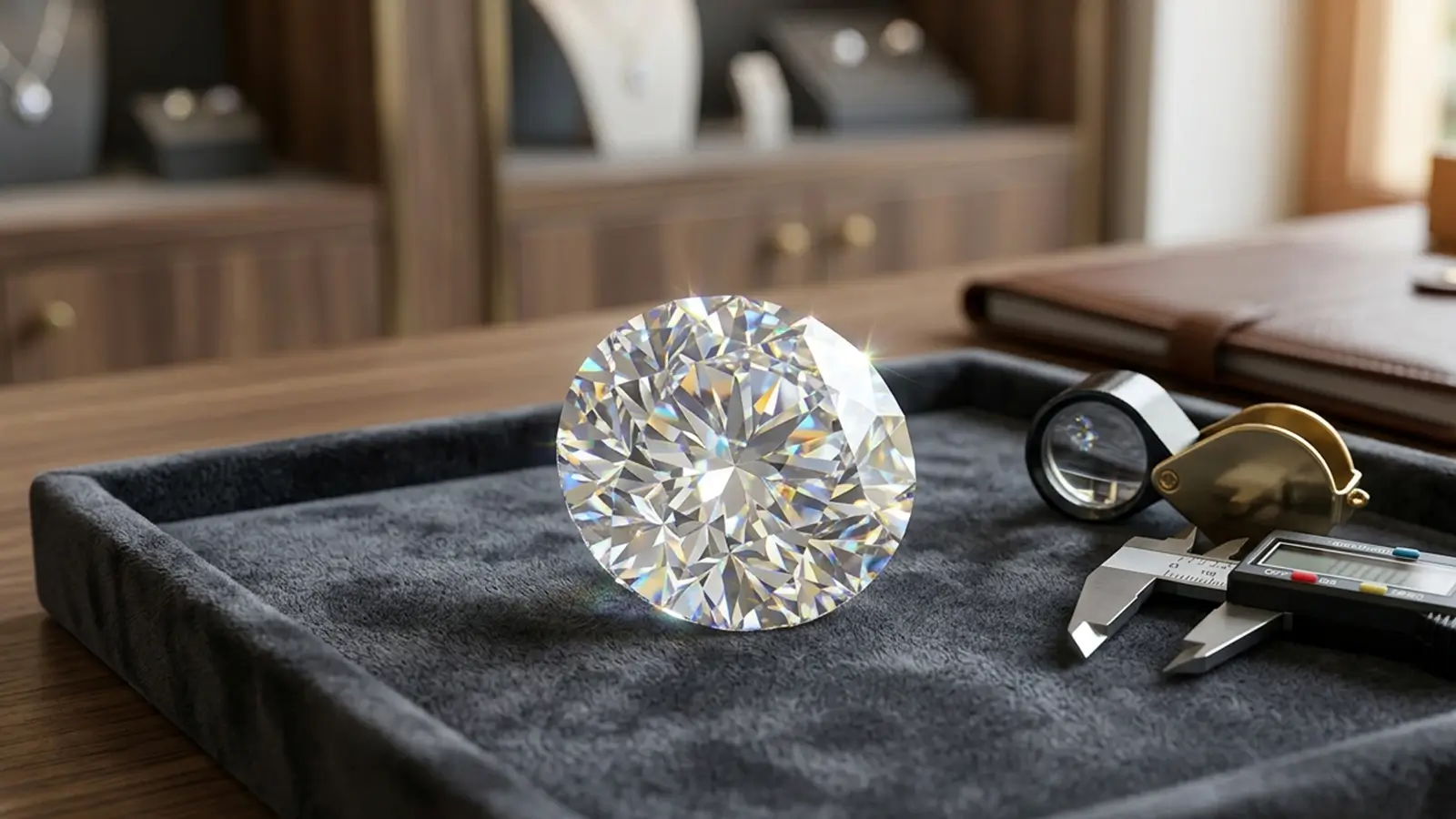
- Diamond value is determined by Carat, Cut, Color, and Clarity — the four Cs — not by retail purchase price
- GIA-certified diamonds consistently achieve 15 to 25 percent higher offers than uncertified comparable stones
- Most diamonds sell for 20 to 50 percent of retail — this is normal, not a low offer
- Round brilliant cut diamonds in the 1-carat-plus range have the strongest secondary market demand
- Insurance appraisals massively overstate market value — never use them as a pricing reference for sales
- A free in-person evaluation from a specialist buyer is the most accurate way to determine current value
- Retail Value vs Market Value: The Critical Distinction
- How the Four Cs Determine Your Diamond’s Worth
- How a GIA Certificate Changes Your Diamond’s Value
- Additional Factors That Affect Diamond Worth
- What Specialist Buyers Actually Pay and Why
- The Right Type of Appraisal for Selling
- Diamond Value by Stone Type and Shape
- Current Diamond Market Conditions in 2026
- How to Get Your Diamond’s Accurate Current Value
- JS Diamonds INC: Expert Valuations Across the US
- Related Reading
- Frequently Asked Questions
The question “how much is my diamond worth?” is one of the most frequently asked questions in the fine jewelry market, and also one of the most frequently misunderstood. Most people assume the answer is somewhere near what they originally paid, or near the number on an insurance appraisal document. In almost every case, both of those figures substantially overstate the diamond’s actual current market value.
Understanding why this gap exists, and more importantly how to accurately determine what your specific diamond will command on today’s secondary market, is the purpose of this guide. At JS Diamonds INC, our team evaluates hundreds of diamonds each year across every size, quality grade, and stone type. This guide reflects exactly what drives the offers we make and why.
1. Retail Value vs Market Value: The Critical Distinction
There are three distinct “values” a diamond can have, and they are rarely the same number. Understanding the difference is the single most important step in setting realistic expectations before any sale.
Retail Replacement Value
What it would cost to walk into a jewelry store today and purchase a comparable stone. This is what insurance appraisals estimate, and it is significantly inflated by retail overhead, brand premiums, and marketing costs. A retail replacement value appraisal is useful for insuring a diamond but is essentially meaningless for determining what you can sell it for.
Fair Market Value
The price a willing, informed buyer would pay a willing, informed seller in an arms-length transaction with neither party under duress. This is the number that matters for estate taxes, divorce settlements, and realistic sale expectations. Fair market value for diamonds is typically 40 to 60 percent of retail replacement value.
Secondary Market Offer Price
The actual cash offer you will receive from a buyer who needs to resell at a profit. This is below fair market value because the buyer must account for their own overhead, holding costs, and resale margin. For most diamonds, expect secondary market offers in the 20 to 50 percent of retail range, with quality certified stones trending higher.
2. How the Four Cs Determine Your Diamond’s Worth
Every diamond buyer in the world uses the four Cs framework established by the GIA to evaluate diamond value. Understanding each one and how it interacts with the others is essential to interpreting any offer you receive.
Carat Weight: The Primary Driver
Carat is a unit of weight: one carat equals exactly 0.20 grams. It is the most powerful single driver of diamond value because diamond prices per carat rise exponentially at recognized weight thresholds. The jump in price-per-carat at the 0.50, 1.00, 1.50, 2.00, and 3.00 carat marks is substantial. A 0.95 carat diamond is worth meaningfully less per carat than a 1.05 carat stone of otherwise identical quality, simply because buyers price the under-1-carat and over-1-carat categories very differently.
Cut: The Value Multiplier
Cut refers not to the shape of the diamond but to the quality of its proportions, symmetry, and polish. An Excellent or Ideal cut maximizes the light returned through the top of the stone, producing the brilliance and fire that make diamonds desirable. A well-cut diamond of modest color and clarity will outperform a poorly cut diamond of superior color and clarity in the secondary market because visual performance is what end buyers perceive and pay for.
Color: The Invisible Grade
Diamond color is graded from D (completely colorless) to Z (visibly yellow or brown). The D through F range commands the highest premiums among buyers who specifically seek colorless stones. The G through J range represents near-colorless and is the sweet spot for most secondary market buyers: colorless enough to appear white in normal settings while being available at significantly lower prices than the top three grades. K and below carry increasing yellow tint visible to the naked eye and command lower premiums accordingly.
Clarity: The Eye-Clean Threshold
Clarity grades measure the presence and visibility of internal inclusions and surface blemishes under 10x magnification. The critical threshold in the secondary market is “eye-clean” — whether inclusions are visible without magnification. SI1 and many SI2 clarity diamonds are eye-clean and represent the most popular secondary market quality tier because they offer significantly lower prices than VS grades while delivering equivalent visible quality to most buyers. I1 and below clarity stones have visible inclusions that meaningfully limit the buyer pool.
| Diamond Profile | Approx. Retail Value | Typical Secondary Market Offer | Notes |
|---|---|---|---|
| 0.5ct, G, VS2, Excellent, GIA Cert | $2,500 – $3,500 | $600 – $1,200 | Sub-carat stones have more limited buyer pool |
| 1.0ct, H, SI1, Excellent, GIA Cert | $6,000 – $9,000 | $2,000 – $4,000 | Strong demand category; eye-clean, well-priced |
| 1.5ct, F, VS1, Excellent, GIA Cert | $15,000 – $22,000 | $6,000 – $10,000 | Premium tier; broad buyer pool from specialist buyers |
| 2.0ct, E, VVS2, Excellent, GIA Cert | $35,000 – $55,000 | $15,000 – $25,000 | Strong recovery rate; sought by high-net-worth buyers |
| 1.0ct, J, I1, Fair cut, No cert | $2,500 – $4,000 | $300 – $700 | Poor cut, visible inclusions, no cert = very limited pool |
3. How a GIA Certificate Changes Your Diamond’s Value
The Gemological Institute of America (GIA) is the world’s most respected independent diamond grading laboratory. A GIA grading report documents your diamond’s four Cs parameters as assessed by trained gemologists using standardized equipment and methodology.
The impact on value is meaningful and measurable. A GIA-certified diamond typically commands a 15 to 25 percent premium over a comparable uncertified stone from specialist buyers for a straightforward reason: the certificate eliminates evaluation uncertainty. When a buyer prices an uncertified stone, they build in a margin for the possibility that their own evaluation might be slightly off. A certificate removes that uncertainty entirely, and buyers pass the savings directly to sellers in the form of higher offers.
Other Laboratory Reports
AGS (American Gem Society) grading reports are also highly respected and typically receive equivalent treatment to GIA in the market. EGL (European Gemological Laboratory) reports historically graded more liberally than GIA — meaning a stone graded G/VS1 by EGL might only be H/VS2 by GIA standards. Buyers typically discount EGL-certified stones significantly relative to equivalent GIA-certified stones. IGI reports have improved in consistency but still trade at a discount to GIA in most secondary markets.
4. Additional Factors That Affect Diamond Worth
Beyond the four Cs and certification, several additional characteristics influence what a specific diamond will command from a specialist buyer.
Shape
Round brilliant cut diamonds have the largest secondary market buyer pool and consistently achieve the best prices relative to quality grade. Fancy shapes (oval, cushion, pear, marquise, princess, emerald, radiant) have narrower buyer pools in the secondary market but can command strong prices when they are of excellent quality and in the 1-carat-plus range where a broader audience of buyers actively seeks them.
Fluorescence
A characteristic of some diamonds is to emit blue light under UV exposure. For D through H color diamonds, medium to strong fluorescence is generally considered a negative that reduces value by 5 to 15 percent compared to non-fluorescent equivalents. For I through M color stones, faint to medium fluorescence can be neutral or slightly positive as it masks the slight yellow tint in natural light.
Symmetry and Polish
Graded separately on GIA reports, symmetry and polish at Excellent or Very Good levels are expected on quality stones. Fair or Poor symmetry in these grades indicates a stone that may appear less brilliant under careful examination and typically reduces secondary market interest.
Provenance and History
Exceptional provenance — a stone documented as coming from a famous collection, a named estate, or a historic source — can command a collector premium above standard market pricing. This applies to a very small percentage of diamonds but is worth documenting if known.
Get Your Diamond’s Accurate Current Value for Free
Our certified specialists at JS Diamonds INC evaluate any diamond — loose or set — with no obligation. Know exactly what your stone is worth in today’s market before making any decisions.
5. What Specialist Buyers Actually Pay and Why
A transparent explanation of how a specialist buyer arrives at an offer helps you evaluate whether any specific offer is fair.
The Buyer’s Cost Structure
A specialist buyer who offers you $3,000 for a diamond needs to eventually sell that stone for more than $3,000 to stay in business. Their cost structure includes: the capital tied up in holding the stone, overhead for their operation, marketing to find end buyers, and the risk that market conditions change before the stone sells. This is why the secondary market offer is always below theoretical fair market value — it is not dishonest, it is the economics of the resale business.
Direct Network Access Changes the Math
Specialist buyers with large direct buyer networks — including retail clients, international trade partners, and estate collectors — can offer more because they can turn over inventory faster and at better margins. This is precisely why specialist buyers like JS Diamonds INC consistently outpay pawn shops and general jewelers who lack the same trade access. Visit our sell diamonds page to understand how our buyer network affects what we can offer.
When Buyers Have Current Demand for Your Stone
If a specialist buyer has a current client actively looking for a stone with your stone’s specific characteristics, the offer may be at the high end of the realistic range because the resale is essentially already arranged. This is another reason to get multiple offers from different specialist buyers — demand profiles vary meaningfully across buyer networks.
6. The Right Type of Appraisal for Selling
If you want an independent assessment before approaching buyers, be specific about the type of appraisal you request. Getting the wrong type produces a number that will mislead rather than help you.
What to Ask For
Request a “fair market value appraisal” specifically. This instructs the appraiser to estimate what your diamond would achieve in a transaction between informed parties rather than what it would cost to replace it at retail. Fair market value is the IRS standard for estate and gift tax purposes and is the closest available independent proxy to secondary market pricing.
Who to Use
Look for appraisers accredited by the American Society of Jewelry Appraisers (ASJA) or who hold the GIA Graduate Gemologist designation. These credentials indicate formal training in diamond evaluation methodology. Avoid appraisers affiliated with buyers who might have an interest in undervaluing your stone.
The Free Specialist Buyer Evaluation
The simplest and most practical approach for most sellers is a free evaluation from a specialist buyer who purchases diamonds regularly. At JS Diamonds INC, our evaluation is conducted by experienced professionals, is entirely free, and provides a live market-based offer rather than a theoretical appraisal number. Visit our diamond buyers NYC page to learn more about our evaluation process.
7. Diamond Value by Stone Type and Shape
While the four Cs are the primary value drivers, the specific type and shape of your diamond affects which buyer category is most likely to offer top dollar for it.
Natural Round Brilliant Diamonds
The most liquid secondary market category. The broadest buyer pool, the most consistent pricing benchmarks, and the easiest to value and sell quickly. If you have a round brilliant in a quality grade, you have the most favorable resale situation in the diamond category. Our loose diamonds buying page provides current criteria for this category.
Natural Fancy Shape Diamonds
Oval, cushion, pear, marquise, emerald, and princess cuts trade at varying discounts to equivalent round brilliants. Current fashion trends favor oval and cushion shapes, giving them narrower discounts than historically seen. Princess cuts have faced softening demand. Emerald cuts at exceptional quality levels can achieve strong premiums among collectors. Our sell your diamonds service covers all fancy shapes.
Antique and Period Cut Diamonds
Old Mine Cut, Old European Cut, and Rose Cut diamonds from pre-modern production periods appeal to a collector market that actively seeks them and is willing to pay premiums unavailable for modern cuts. If your diamond appears to have an unusual facet pattern or a distinctly different proportional appearance from modern stones, have it evaluated by a specialist who understands the period diamond market. Our Old Mine Cut guide covers the collector market for antique stones.
Lab-Grown Diamonds
Lab-grown diamonds have rapidly declining secondary market values and limited resale demand from specialist buyers. If you have a lab-grown diamond, be aware that the secondary market for them is fundamentally different from natural diamonds, with offer rates that are a much smaller percentage of the original retail price. Our team can evaluate lab-grown stones but will be transparent about current market conditions.
8. Current Diamond Market Conditions in 2026
The diamond market in 2026 operates in a context shaped by several significant forces that sellers should understand when assessing timing and offers.
The growth of the lab-grown diamond sector, which now accounts for a substantial share of new jewelry purchases in the US, has softened demand for lower-quality natural diamonds in the sub-carat range. This has compressed secondary market prices for stones under 0.75 carats in standard commercial grades.
However, the effect on quality natural diamonds above 1 carat has been the opposite of what many expected. The natural diamond premium — the price differential between natural and lab-grown stones — has widened as consumers and collectors increasingly recognize and value the distinction. This makes the current environment favorable for sellers with quality certified natural diamonds in the 1 to 3-plus carat range.
For detailed current pricing context and how global market conditions are affecting secondary market offers, our loose diamonds investment guide covers the market dynamics in detail.
9. How to Get Your Diamond’s Accurate Current Value
Armed with an understanding of the factors that drive diamond value, here is the practical process for getting the most accurate picture of what your specific stone is worth in today’s market.
- Locate Your Certificate: Find any existing GIA, AGS, or other laboratory report. Check the stone’s carat weight, cut grade, color grade, and clarity grade as documented.
- Research Comparable Sales: Diamond auction results from reputable houses and wholesale price benchmarks from tools like the Rapaport Diamond Report can give directional guidance for what comparable stones have achieved.
- Get a Professional In-Person Evaluation: Book a free appointment at JS Diamonds INC. Our specialists physically examine, weigh, and grade the stone against current market data and provide a written, market-based offer with no obligation.
- Get a Second Offer: For stones valued above $3,000, a second specialist opinion adds meaningful negotiating context. Legitimate buyers welcome comparison shopping and the offer spread between quality buyers is typically narrow, confirming what a fair market offer looks like.
- Evaluate Offers as a Percentage of Melt-Equivalent Wholesale Value: A useful benchmark for quality certified stones is whether the offer reflects 40 to 50 percent or better of the current Rapaport wholesale price for equivalent characteristics. Offers significantly below this range warrant questioning.
10. JS Diamonds INC: Expert Diamond Valuations Across the US
JS Diamonds INC provides free, professional diamond evaluations and same-day cash offers from our primary New York City location. We serve sellers from across the metropolitan area and work with out-of-state sellers for significant estate collections.
- Diamond Buyers NYC
- New York Diamond Buyers
- Diamond Buyers Upper West Side Manhattan
- Diamond Buyers Upper East Side Manhattan
- Diamond Buyers West Village NYC
- Diamond Buyers DUMBO NYC
- Diamond Buyers Scarsdale Westchester
- NYC Diamond Ring Buyers
- Sell Diamonds NYC
- Sell Diamonds in NYC
- Sell Diamonds New York
- Sell Diamonds in New York
11. Related Reading
12. Frequently Asked Questions
What is the best way to find out what my diamond is worth?
The most accurate and practical method is a free in-person evaluation from a specialist diamond buyer. At JS Diamonds INC, our certified specialists examine and weigh your stone, grade it against the four Cs, and provide a written market-based offer with no obligation. This gives you a real, current market data point rather than a theoretical appraisal estimate.
Does my diamond’s retail price reflect its current value?
No. Retail jewelry prices include significant markups for store overhead, marketing, brand premiums, and sales staff that cannot be recovered on resale. Most diamonds sell for 20 to 50 percent of their original retail price on the secondary market. The secondary market value is driven by the stone’s physical characteristics and current buyer demand. Visit our diamond market insights page for current context.
Does a larger diamond always mean a higher value?
Carat weight is the most impactful single factor but does not determine value alone. A large diamond with very poor cut, low color grade, or significant inclusions may be worth less than a smaller, better-quality stone. The four Cs work together to determine value. A 1.5 carat diamond at I color, I2 clarity, and Fair cut may be worth less than a 1.0 carat diamond at G color, VS1 clarity, and Excellent cut. See our loose diamonds valuation guide for more examples.
How does a GIA certificate affect my diamond’s value?
A GIA certificate typically increases secondary market offers by 15 to 25 percent compared to uncertified comparable stones because it eliminates evaluation uncertainty for buyers. For stones above 1 carat, the investment in a GIA grading report before selling often more than pays for itself in a higher offer. Buyers at JS Diamonds INC price certified stones at the higher end of the offer range for their quality grade.
What makes some diamonds worth significantly more than others?
The highest-value diamonds combine larger carat weight (above 1 carat, especially above 2 carats), excellent cut quality, colorless or near-colorless grades (D through H), high clarity (VS2 or better), round brilliant shape, strong symmetry and polish grades, no problematic fluorescence, and GIA certification. The further a stone is from these parameters, the more limited its buyer pool and the lower its secondary market value. Our diamond program page details the grades we value most highly.
Can I find out my diamond’s worth online without an in-person appraisal?
Online diamond price calculators provide directional estimates for certified stones whose four Cs grades are known. However, they cannot account for nuances in cut execution, fluorescence characteristics, or specific inclusion positions and types that meaningfully affect real buyer offers. For any decision based on diamond value, an in-person professional evaluation from a specialist like JS Diamonds INC provides significantly more reliable information.
Does fluorescence affect my diamond’s resale value?
Yes, depending on the color grade. Strong fluorescence in colorless and near-colorless grades (D through H) typically reduces secondary market value by 5 to 15 percent compared to non-fluorescent equivalents, because some buyers perceive it negatively under certain lighting conditions. Faint to medium fluorescence in lower color grades (I through M) can be neutral or slightly positive. Our specialists evaluate fluorescence in the context of the full stone profile during your free evaluation.
Will my diamond be worth more in the future?
Natural diamond prices have appreciated over long historical periods but with meaningful volatility. The growth of lab-grown diamonds has softened natural diamond pricing in lower quality tiers while the natural premium in upper quality tiers has actually widened. Diamonds should not be considered guaranteed appreciating assets. If you are considering holding rather than selling, consult a financial advisor. If you decide to sell, current conditions are favorable for quality certified natural stones. Book a consultation with our team to discuss your specific situation.
