
Key Highlights
- Scrap gold and broken gold jewelry are valued purely by weight and karat purity, not appearance or condition.
- The four most common karats sold as scrap are 10K, 14K, 18K, and 22K, each containing a different percentage of pure gold.
- Spot price at the time of sale directly determines how much pure gold content is worth per gram or troy ounce.
- Reputable buyers use XRF spectrometry or acid testing, not guesswork, to verify purity before making an offer.
- JS Diamonds Inc offers same-day cash payment with no hidden fees or deductions after the offer is agreed.
- Broken chains, bent rings, mismatched earrings, and dental gold all qualify as scrap gold and carry real monetary value.
In This Article
- What Is Scrap Gold and What Qualifies?
- How Scrap Gold Is Valued: The Calculation Explained
- Types of Scrap Gold Jewelry Buyers Accept
- Karat Purity and Its Effect on Your Payout
- What Happens at a Gold Buying Appointment
- Red Flags to Watch For When Selling Scrap Gold
- How to Maximise Your Scrap Gold Payout
- Choosing the Right Buyer: A Practical Guide
- Best Practices Before You Sell
- JS Diamonds Inc Serves Sellers Nationwide
- Related Reading
- Frequently Asked Questions
That tangled necklace in your drawer, the engagement ring from a relationship long over, the single earring with no match, the bent bangle your child sat on by accident – all of these are worth real money right now. Selling scrap gold is one of the fastest ways to convert idle assets into immediate cash, and with gold trading at elevated levels in 2026, the timing could not be more favourable for sellers.
Yet most people who bring broken gold jewelry to a buyer leave money on the table. They do not know what their pieces are worth before walking in, they do not understand how purity affects the calculation, and they cannot tell a fair offer from a lowball one. This guide fixes that. JS Diamonds Inc breaks down exactly how scrap gold is priced, what the buying process looks like, and how to ensure you are paid fairly for every gram.
1. What Is Scrap Gold and What Qualifies?
Scrap gold refers to any gold-containing item that is no longer useful in its current form and is destined to be refined back into pure metal. The term covers a wider range of items than most sellers realise.
Items That Qualify as Scrap Gold
Any solid karat gold item qualifies, regardless of its physical state. This includes broken necklaces and chains, cracked or bent rings, single earrings without pairs, clasps and findings, gold dental crowns and bridges, gold coins and bars that are damaged or partial, vintage brooches and pins, watch cases made from solid gold, and gold ingots or nuggets. The defining criterion is that the item contains a measurable percentage of pure gold.
Items That Do Not Qualify as Standard Scrap
Gold-plated jewelry – pieces with only a micron-thin electroplated surface – holds negligible scrap value because the gold layer is too thin to refine economically. Gold-filled items contain more gold by regulation (at least 1/20th of total weight) and may carry modest value. Vermeil, which is gold-plated sterling silver, is treated primarily as silver scrap. If you are unsure which category your pieces fall into, a professional test at JS Diamonds Inc’s gold buying service will confirm this immediately.
Do not discard dental gold. Crowns, bridges, and inlays cast between 10K and 18K are among the most overlooked sources of scrap value. A single crown can yield $40 to $120 depending on current spot price and purity.
2. How Scrap Gold Is Valued: The Calculation Explained
The value of any scrap gold item is a function of three variables: its weight, its purity, and the current spot price of gold. Understanding how these interact lets you walk into any buying appointment with a realistic number in mind.
The Core Formula
The basic calculation is: (Weight in grams) x (Gold purity as a decimal) x (Spot price per gram) = Melt value. Buyers then apply a percentage of melt value as their offer, which reflects their refining costs, overhead, and margin. Reputable buyers offer between 75 and 92 percent of melt value for standard scrap. Our guide on how much your gold is worth walks through this formula with worked examples.
Understanding the Buyback Percentage
A buyer offering 70 percent of melt value on 18K gold is giving you 70 percent of what the pure gold content is worth on the open market that day. A buyer offering 90 percent is giving you significantly more. The difference on a 20-gram piece at current spot prices can easily exceed $100, which is why comparing offers matters. The gold sell price page at JS Diamonds Inc shows current offer rates updated daily.
3. Types of Scrap Gold Jewelry Buyers Accept
Scrap gold comes in many forms, and professional buyers at JS Diamonds Inc’s What We Buy page are equipped to assess all of them accurately.
Broken and Damaged Jewelry
This is the most common category. Broken clasps, snapped chains, cracked shanks, and bent settings all retain their full gold content. A broken 18K bracelet is worth exactly the same as an intact 18K bracelet of the same weight. Physical damage affects resale value but never scrap value.
Outdated and Unwanted Jewelry
Pieces that are stylistically dated, no longer worn, or simply unwanted can be sold as scrap even if they are in perfect condition. This includes inherited jewelry that does not suit your style, duplicate pieces, and costume-adjacent designs that hold little resale appeal. The understanding gold jewelry value article explains when condition matters and when it does not.
Mixed Lots and Partial Sets
Buyers accept mixed lots readily. You can bring a bag of assorted items from different karats, different styles, and different eras. Each piece is weighed and tested individually, or sorted by karat group and weighed in batches, depending on the buyer’s process.
4. Karat Purity and Its Effect on Your Payout
Gold karat is the single most important factor in determining your scrap payout. Understanding the difference between 10K and 18K gold is not just academic – it directly changes how much cash you receive. Our dedicated gold purity chart explains each karat in detail.
| Karat | Purity (%) | Millesimal Fineness | Typical Use | Value vs 24K |
|---|---|---|---|---|
| 10K | 41.7% | 417 | Fashion jewelry, class rings | 41.7% |
| 14K | 58.3% | 585 | Engagement rings, fine jewelry | 58.3% |
| 18K | 75.0% | 750 | High-end jewelry, watches | 75.0% |
| 22K | 91.7% | 916 | Coins, bullion, South Asian jewelry | 91.7% |
| 24K | 99.9% | 999 | Investment bars, electronics | 100% |
Many pieces carry no visible stamp. This is common in very old items, foreign-made jewelry, or pieces where the hallmark has worn away. In these cases, professional buyers use either acid testing or X-Ray Fluorescence (XRF) spectrometry to determine exact purity before making any offer. Never accept an offer based on assumed karat without confirmation.
Get a Free, No-Obligation Scrap Gold Assessment
Bring your broken or unwanted gold to JS Diamonds Inc and receive an immediate offer based on verified weight and purity. No appointment needed for walk-in assessments.
5. What Happens at a Gold Buying Appointment
Walking into a professional gold buying appointment for the first time can feel intimidating. Knowing the step-by-step process removes uncertainty and helps you evaluate whether a buyer is operating with integrity.
Step 1: Visual Inspection and Sorting
The buyer examines all items visually and sorts them by apparent karat based on visible stamps. This is a preliminary step only. No offer should be made at this stage.
Step 2: Purity Testing
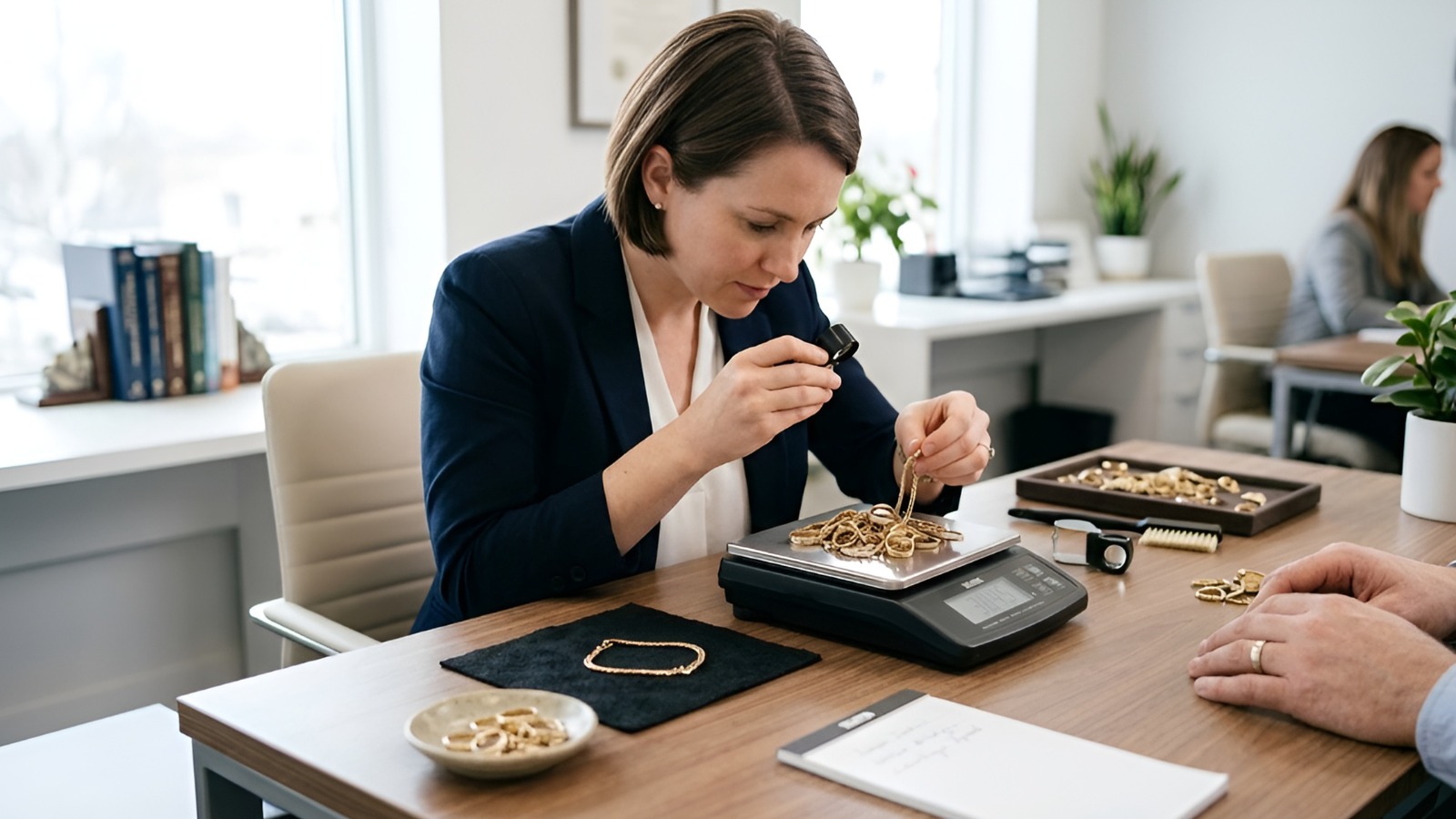
Reputable buyers test every item individually. Acid testing involves applying nitric acid solutions of different concentrations to a small scratch of the metal. XRF spectrometry is non-destructive and measures elemental composition instantly. Both methods are accurate. Any buyer who offers a price without testing is either assuming karat (and likely lowballing) or not operating at a professional standard.
Step 3: Weighing
Items are weighed on a calibrated scale, typically in grams or troy ounces. Ask to watch this process and verify the scale shows zero before each item is placed. Reputable buyers weigh in grams and use scales accurate to 0.01 grams.
Step 4: Offer Calculation and Presentation
The buyer applies the current spot price and their buyback percentage to arrive at a figure. This should be shown transparently. You are under no obligation to accept. Review our guidance on how to sell jewelry without hidden fees to understand what deductions are legitimate and which ones are warning signs.
6. Red Flags to Watch For When Selling Scrap Gold
The secondary gold market includes many buyers who operate ethically, but also some who use tactics designed to reduce what they pay you. Knowing these red flags protects your financial interest.
Refusing to Show Their Testing Process
Any legitimate buyer will test in front of you. If a buyer disappears into a back room and returns with a number, ask to see the testing being performed or take your items elsewhere.
Weighing in Pennyweights Without Disclosure
Some buyers quote offers in pennyweights (dwt) rather than grams. Since 1 gram equals approximately 0.643 pennyweights, a price of $X per pennyweight sounds higher but may actually represent a lower rate than $X per gram. Always convert to grams for comparison.
Lowball First Offers With Artificial Time Pressure
Pressure tactics such as “this offer is only valid for the next ten minutes” or “gold prices are about to drop” are negotiation strategies, not facts. Spot price is publicly available and does not change minute-to-minute in normal trading conditions. Take your time.
Deducting for Stones Without Offering to Assess Them
If your piece contains gemstones, a buyer deducting the estimated stone weight from the gold weight is standard practice. However, you should also be offered a separate assessment of any stones. A diamond set in a broken ring has its own value. Our diamond buying service evaluates stones independently from their gold settings.
7. How to Maximise Your Scrap Gold Payout
A few simple steps before you sell can meaningfully increase what you receive.
Know Your Karat Before You Go
Check every item for a karat stamp. Common locations include the inside of ring shanks, the clasp area on necklaces and bracelets, and the post of earrings. Knowing you have 18K gold before the appointment prevents a buyer from low-testing or misrepresenting purity.
Separate by Karat When Possible
Keep 10K, 14K, 18K, and 22K items in separate bags. Mixing them in one batch risks having the lot valued at the lowest karat present. The gold jewelry as an asset article explains how organised presentation affects buyer confidence and offer quality.
Get Multiple Offers
There is no cost to receiving multiple assessments. Visit two or three buyers and compare. The spread between the lowest and highest offer can be 15 to 20 percent. Given that the top offer on $1,000 of scrap may be $150 to $200 more than the lowest, the extra time is always worth it.
Sell During Strong Spot Price Periods
Gold prices fluctuate daily. Selling when spot is at a recent high rather than a recent low can add 5 to 10 percent to your payout on the same items. Monitoring spot price for even a few weeks before selling can be financially meaningful.
8. Choosing the Right Buyer: A Practical Guide
Not all gold buyers are created equal. Whether you sell in New York, Chicago, Houston, or online, the criteria for evaluating a buyer remain consistent.
Credentials and Track Record
Look for buyers who are established businesses with physical locations, verifiable reviews, and a clear online presence. Members of industry associations such as the Jewelers of America or the American Gem Society operate under codes of conduct that protect sellers.
Transparency in Pricing
The buyer should be able to show you live or recent spot price data and explain their buyback percentage clearly. The best buyers, like JS Diamonds Inc in NYC, publish their methodology so you know the rate before you arrive.
Same-Day Payment
For in-person sales, same-day cash or bank transfer is the industry standard. Mail-in programs that hold your items for several days before issuing a check introduce both risk and uncertainty. If you need fast payment, choose an in-person buyer with a same-day guarantee.
Willingness to Assess Additional Items
A buyer who also handles diamonds, silver, and watches in the same appointment is a significant convenience advantage. Bringing everything to one appointment saves time and ensures you are not leaving value on the table from items you did not realise had worth.
9. Best Practices Before You Sell
Preparation takes less than 30 minutes and measurably improves outcomes. Follow these steps before any selling appointment.
Photograph Everything
Take clear photographs of all items before handing them over. This creates a record of the items’ condition and any visible hallmarks. Photographs protect you in the unlikely event of a dispute.
Do Not Clean Heavily
Light cleaning to remove surface dirt is fine. However, avoid harsh chemical cleaning that could affect any plating, obscure hallmarks, or alter the appearance of gemstones. Scrap gold does not need to look pristine; it needs to be identifiable.
Keep Certificates and Receipts If Available
Original purchase receipts, GIA certificates for any diamonds, and any appraisal documents should be brought along. While they do not change scrap gold value directly, certificates for diamonds can significantly increase the stone’s value assessment. Learn more about getting cash for diamonds on the same day.
Check the Scale
Ask the buyer to zero the scale with an empty container before weighing your items. This is a basic courtesy at any legitimate operation and ensures you are not losing weight to the tare of a pre-loaded container.
10. JS Diamonds Inc Serves Sellers Nationwide
Whether you are in the heart of Manhattan or anywhere across the United States, JS Diamonds Inc provides trusted scrap gold buying services with transparent pricing, verified testing, and same-day payment. Our network of service areas includes major cities and suburban markets.
New York City Locations
Westchester and New Jersey
Major US Cities
11. Related Reading
Gold Selling Guides
Services and Products
Company Pages
Key Takeaways
- Scrap gold value is determined by weight, karat purity, and current spot price – condition does not matter.
- The difference between the best and worst offer can exceed 20 percent; always get multiple assessments.
- Professional buyers use acid testing or XRF spectrometry – never accept an offer without witnessed testing.
- Broken chains, dental gold, single earrings, and outdated pieces all qualify and carry full scrap value.
- Preparation (sorting by karat, photographing items, knowing your hallmarks) leads to better outcomes.
- JS Diamonds Inc pays same-day with transparent pricing and no hidden deductions after the offer is accepted.
12. Frequently Asked Questions
Can I sell broken or tangled gold chains?
Yes. Broken chains, bent rings, and tangled necklaces are all accepted as scrap gold. The condition does not reduce the gold content, so you receive the same melt value regardless of damage. Visit our sell gold jewelry page for more detail.
Does the gemstone in my broken ring have any value?
It may. Diamonds and certain precious stones can be assessed separately from the gold setting. JS Diamonds Inc evaluates stones independently and factors any additional value into your offer, so you are paid for the full worth of each item.
How do I know if my gold is real before bringing it in?
Look for a hallmark or karat stamp inside the band or on the clasp. Common marks include 10K, 14K, 18K, 22K, 24K, or 375, 585, 750, 916, 999. If no mark is visible, our guide on how to tell if gold is real explains simple at-home tests, and a professional acid test or XRF scan will confirm purity definitively.
What is the difference between melt value and resale value?
Melt value is the worth of the pure gold content at current spot price. Resale value applies to intact pieces with maker signatures, antique status, or collector demand. Scrap buyers pay melt value; antique dealers or specialist buyers may pay more for rare signed pieces. Our article on understanding gold jewelry value explores both dimensions.
Do gold-plated or gold-filled items have scrap value?
Gold-plated items carry only a micron-thin coating and have negligible scrap value. Gold-filled items contain a legally mandated minimum of 5 percent gold by weight, which can produce a small but real payout, though significantly less than solid karat gold.
How quickly will I receive payment?
JS Diamonds Inc pays on the same day for in-person transactions. Once your items are weighed, tested, and an offer is agreed upon, you walk out with cash or a same-day bank transfer. See our sell gold for cash page for details on payment options.
Will spot price changes affect my offer between the appointment and payout?
Offers are locked at the time of agreement. Any spot price fluctuation that occurs after you accept the offer does not affect your payout amount. For context on how spot price works, read our companion article on the gold sell price.
Should I melt or separate my gold before selling?
No. Never melt items yourself as this can introduce impurities and reduce payout. Bring items as-is. Professional buyers perform their own refinery-grade testing using XRF spectrometry and acid analysis to determine precise purity.
Is dental gold worth selling?
Yes. Dental gold crowns, bridges, and inlays are typically cast at 10K to 18K and carry real scrap value. They should be clean and dry before assessment. Bring them to any JS Diamonds Inc gold store for a fast, accurate evaluation.
