


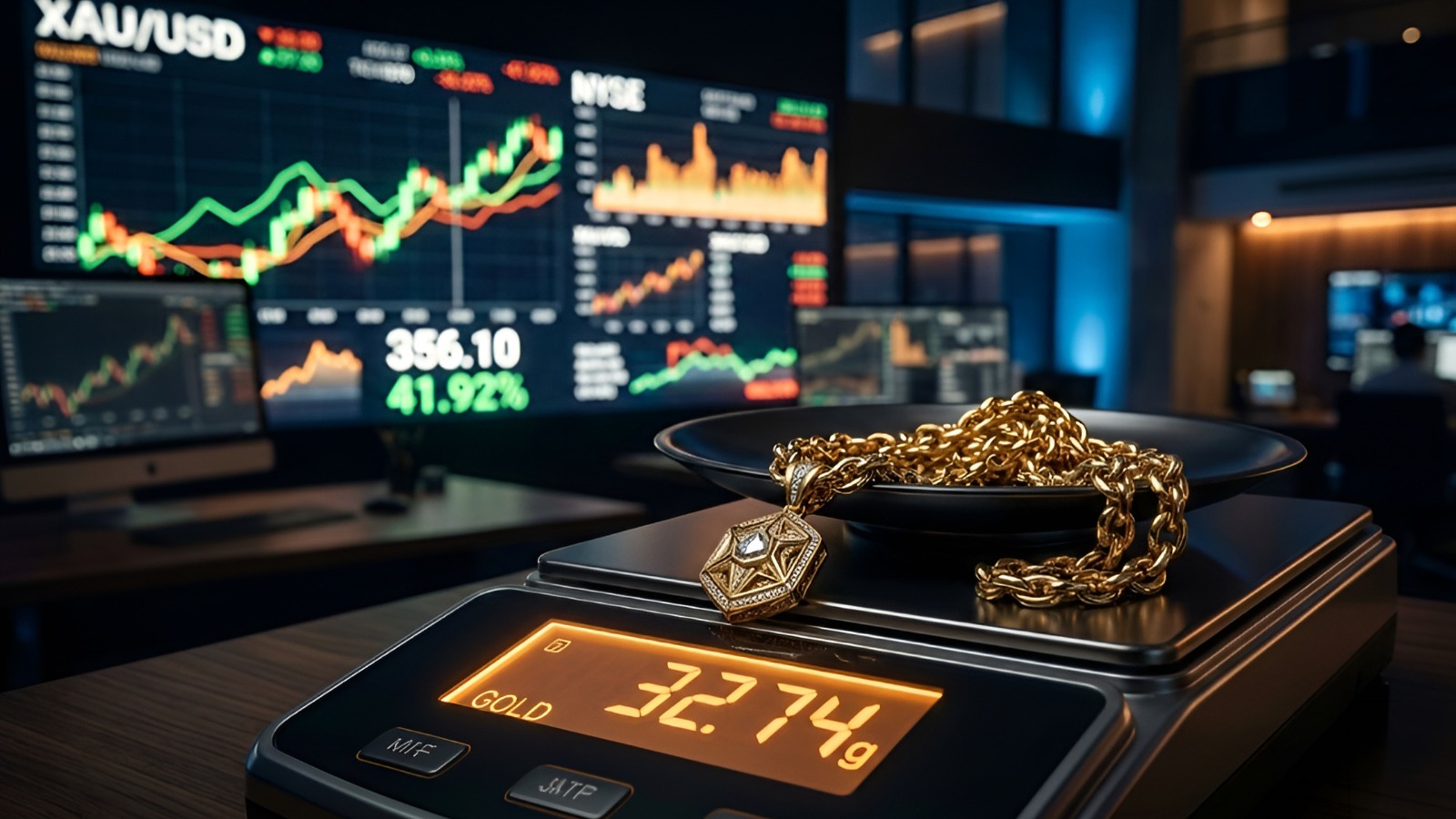
Key Highlights
- Gold spot price is quoted per troy ounce globally; dividing by 31.1035 gives the per-gram price that directly sets your sell offer.
- Every movement in spot price – even a $10 shift per troy ounce – changes the cash value of your gold by a measurable amount.
- Reputable buyers track live spot price throughout the trading day and update offers accordingly.
- Karat purity is applied as a multiplier to spot price, meaning 18K gold captures 75 percent of the per-gram gold price.
- Monitoring spot price for even two to four weeks before selling can meaningfully improve your payout timing.
- JS Diamonds Inc offers transparent, spot-price-linked buyback rates with same-day payment in every market it serves.
In This Article
- What Is Gold Spot Price and Why It Matters to Sellers
- From Troy Ounce to Per-Gram: The Conversion Sellers Need
- How Spot Price Movements Directly Affect Your Sell Offer
- Karat as a Multiplier: Applying Spot Price to Real Jewelry
- What Drives Gold Price Movements Day to Day
- How to Read Live Gold Price Data as a Seller
- Timing Your Sale: A Practical Framework
- How Buyers Use Spot Price to Calculate Your Offer
- Best Practices for Spot-Price-Aware Selling
- JS Diamonds Inc Serves Gold Sellers Across the US
- Related Reading
- Frequently Asked Questions
If you have ever wondered why two gold buyers gave you different offers on the same day for the same piece of jewelry, the answer almost always comes back to spot price – and how each buyer applies it. Gold is a globally traded commodity. Its price updates continuously every business day across exchanges in New York, London, Shanghai, and beyond. Every gram of gold you own is linked to that live market number, and understanding how it works is the most powerful thing a seller can know before walking into any buying appointment.
JS Diamonds Inc has built its reputation on transparent, spot-price-linked offers. This guide explains the mechanics behind live gold pricing, how it translates into the actual dollars you receive, and how to use that knowledge to sell at the right time and to the right buyer. Whether you plan to sell gold jewelry, gold coins, or raw scrap, this framework applies directly to your situation.
1. What Is Gold Spot Price and Why It Matters to Sellers
Gold spot price is the price at which one troy ounce of pure (24K) gold can be bought or sold for immediate delivery. It is not a retail price or an average – it is the live market clearing price driven by continuous global trading activity on commodity exchanges including COMEX in New York and the London Bullion Market Association (LBMA).
Why Spot Price Is the Foundation of Every Offer
When a gold buyer makes you an offer, they are not pulling a number from thin air. They start with the current spot price, calculate the pure gold content in your item (weight multiplied by purity), apply their buyback percentage, and arrive at the figure they quote you. The gold sell price at any reputable buyer is a direct function of live spot. Understanding this means you can verify any offer in real time using publicly available market data.
Spot Price vs Retail Price vs Buy Price
Spot price is the wholesale market price. Retail gold prices (what you pay in a jewelry store) are typically 20 to 300 percent above spot, depending on craftsmanship and brand. Buyback prices (what you receive when selling) are typically 75 to 92 percent of melt value, which is itself based on spot. The gap between what you paid at retail and what you receive at scrap reflects the entire retail markup collapsing when a piece is sold for its metal content alone. This is why understanding gold jewelry value before you sell is so important.
The LBMA publishes a gold price fix twice daily at 10:30 AM and 3:00 PM London time. These benchmarks are used by institutional buyers globally. Consumer gold buyers typically track spot price in real time rather than the fix, but both reference the same underlying market.
2. From Troy Ounce to Per-Gram: The Conversion Sellers Need
Gold spot price is quoted universally in US dollars per troy ounce. Since most consumer gold jewelry is small enough to be measured in grams rather than ounces, sellers need to convert this figure into a per-gram price before they can calculate what their pieces are worth.
The Conversion Formula
One troy ounce equals exactly 31.1035 grams. The per-gram price is therefore the spot price divided by 31.1035. At a spot price of $3,100 per troy ounce, the per-gram price of pure gold is $3,100 divided by 31.1035, which equals approximately $99.67 per gram. This is the starting point for all value calculations. Our gold worth calculation guide provides worked examples you can follow with your own items.
| Spot Price (per troy oz) | Per Gram (24K Pure) | Per Gram (18K) | Per Gram (14K) | Per Gram (10K) |
|---|---|---|---|---|
| $2,800 | $90.02 | $67.51 | $52.48 | $37.54 |
| $2,900 | $93.23 | $69.92 | $54.35 | $38.88 |
| $3,000 | $96.44 | $72.33 | $56.22 | $40.22 |
| $3,100 | $99.67 | $74.75 | $58.12 | $41.57 |
| $3,200 | $102.88 | $77.16 | $59.98 | $42.90 |
This table makes visible something important: a $400 swing in spot price per troy ounce translates into a difference of $12.86 per gram of pure gold. On a 20-gram 18K bracelet, that single variable changes the melt value by approximately $193 before any buyback percentage is applied.
3. How Spot Price Movements Directly Affect Your Sell Offer
The relationship between spot price and your offer is linear and direct. Every dollar per troy ounce that gold moves up or down changes what you receive by a proportional amount. This is not theoretical – it is the arithmetic reality of commodity-backed buying.
A Worked Example With a Real Piece
Consider a 14-gram 18K gold necklace. Its pure gold content is 14 grams multiplied by 0.75 (18K purity), which equals 10.5 grams of pure gold. If spot is at $3,000 per troy ounce ($96.44 per gram), the melt value is $96.44 multiplied by 10.5, equalling $1,012.62. At an 85 percent buyback rate, your offer is $860.73. If spot rises by $150 to $3,150 per troy ounce, the melt value increases to $1,060.76, and the same 85 percent offer becomes $901.65. That is an additional $41 from a single spot price movement, on just one piece of jewelry.
Intraday vs Day-to-Day Movements
Gold prices move intraday in response to trading activity, economic data releases, currency fluctuations, and geopolitical headlines. A single day can see movements of $20 to $50 per troy ounce or more during high-volatility events. Day-to-day movements compound over weeks and months into the larger trends that create meaningful differences in selling windows. Monitoring the gold market as a financial asset helps sellers develop a sense of price ranges over time.
4. Karat as a Multiplier: Applying Spot Price to Real Jewelry
Spot price gives you the value of pure gold. But almost all jewelry is alloyed – mixed with other metals like copper, silver, and zinc to add durability, colour, or reduce cost. The karat system communicates exactly what fraction of an alloy is pure gold, and that fraction is the multiplier you apply to spot price. Our detailed gold purity chart explains each karat grade in full.
The Karat-to-Purity Conversion
The purity fraction is simply the karat number divided by 24. 18K is 18 divided by 24, which is 0.75 or 75 percent pure gold. 14K is 14 divided by 24, which is 0.5833 or 58.3 percent. 10K is 10 divided by 24, which is 0.4167 or 41.7 percent. When applied to the spot price per gram, these fractions give the effective gold value per gram of each alloy.
Why Mixed-Karat Collections Need Individual Assessment
A common mistake sellers make is treating a mixed lot as though it were all the same karat. A bag containing five 18K items and three 10K items should be valued as two separate groups. If the entire lot is appraised as 14K (the midpoint), the 18K pieces are undervalued and the 10K pieces are overvalued – but in practice, buyers who batch-assess mixed lots without sorting almost always err toward the lower karat, reducing your total payout.
Before visiting any buyer, stamp-sort your items into karat groups and place each group in a clearly labelled zip-lock bag. This simple step prevents batch undervaluation and signals to the buyer that you are an informed seller.
Get a Spot-Price-Linked Offer From JS Diamonds Inc
Our offers are calculated transparently using live spot price, verified purity testing, and published buyback rates. Walk in or book a consultation and know exactly what your gold is worth today.
5. What Drives Gold Price Movements Day to Day
Gold does not trade in a vacuum. Its price responds to a specific set of global variables that sellers can monitor to understand whether prices are likely to be rising, falling, or stable over a given period.
US Dollar Strength
Gold is priced in US dollars globally. When the dollar strengthens relative to other currencies, gold becomes more expensive for international buyers, which tends to reduce demand and put downward pressure on price. Conversely, a weaker dollar tends to support or elevate gold prices. This inverse relationship is one of the most consistent patterns in commodity markets, documented extensively by institutions such as the World Gold Council and the Federal Reserve Bank of St. Louis.
Inflation and Real Interest Rates
Gold is widely held as an inflation hedge. When consumer price inflation rises faster than nominal interest rates (producing negative real rates), the opportunity cost of holding gold falls – it competes more favourably with interest-bearing assets. High inflation environments historically correlate with elevated gold prices, which is relevant to sellers monitoring whether 2026 conditions remain supportive for gold pricing.
Central Bank Demand
Central banks globally, particularly in emerging markets, have been net buyers of gold for several consecutive years as reported by the World Gold Council’s annual demand trends data. When central bank buying increases, it supports prices by absorbing significant supply. For consumer sellers, this structural demand provides a floor under pricing during periods where speculative interest wanes.
Geopolitical and Market Risk Events
Gold’s status as a safe-haven asset means it tends to spike during periods of geopolitical stress, financial market volatility, or sovereign credit events. Sellers who are not in a rush to liquidate can use these spikes as natural exit points. The relationship between equity market downturns and gold price appreciation is documented across multiple market cycles by financial research institutions including the IMF and Goldman Sachs Research.
6. How to Read Live Gold Price Data as a Seller
Live gold price is freely available from multiple financial data sources. The challenge for individual sellers is knowing which numbers to look at, how to interpret short-term movements, and how to translate chart data into a realistic sense of where price is likely to be during the next few weeks.
Key Sources for Live Spot Price
Reliable sources for real-time or near-real-time gold spot price include financial platforms such as Bloomberg, Reuters, Kitco, and the LBMA’s own published daily prices. Major financial news sites also carry live commodity quotes. These sources quote the spot price in USD per troy ounce as the standard global benchmark. For sellers based in the United States, USD per gram is the most practical unit for calculating individual piece values.
Understanding Price Charts
A standard gold price chart shows closing prices over time, typically displayed as a line or candlestick chart. For sellers, the most useful views are the 30-day and 90-day charts, which give a sense of recent trading range without getting lost in decade-long historical trends. Look for the recent high, the recent low, and where current price sits within that range. Selling near the top of a 30-day range is more advantageous than selling at a recent low.
Intraday Timing
If you have flexibility on the time of your selling appointment, the overlap between London and New York market hours (approximately 8:00 AM to 12:00 PM Eastern Time) is typically when gold liquidity is highest and spreads are tightest. Prices quoted during these hours are most reflective of true market value. This is a secondary consideration for most sellers but can matter in very large transactions.
7. Timing Your Sale: A Practical Framework
Timing the gold market perfectly is impossible, even for professional traders. However, sellers can apply a simple, data-informed framework to avoid selling at a cyclical low and improve their expected payout.
The 30-Day Range Method
Check the 30-day gold price chart on any major financial data site. Identify the high and low of the range. If current price is in the lower third of this range, consider waiting one to two weeks to see if price recovers. If current price is in the upper half, conditions are relatively favourable. This method does not require any predictive ability – it simply uses recent range as a benchmark.
Event-Based Selling Windows
Specific macroeconomic events reliably create elevated gold prices. These include US Federal Reserve announcements of rate cuts or pauses, consumer price index (CPI) data releases showing elevated inflation, US dollar weakness driven by fiscal or monetary policy shifts, and geopolitical escalation events. If you are aware of upcoming events with a historical track record of supporting gold, and you are not under immediate financial pressure to sell, delaying until after such an event can be rewarding. The trade-in versus cash sale decision is also affected by timing, as explored in our guide on trade-in vs cash sale for jewelry.
When to Stop Waiting
Market timing has diminishing returns for individual sellers. If you have been monitoring for three to four weeks and price has moved laterally, the opportunity cost of further delay (lost cash flow, continued storage risk) likely outweighs the potential gains from a modest price improvement. At that point, focusing on maximising your buyback percentage by choosing the best buyer is more productive than waiting for a higher spot price.
8. How Buyers Use Spot Price to Calculate Your Offer
A transparent buyer’s pricing methodology should be explainable in full detail. If a buyer cannot tell you exactly how they arrived at their offer, that is a warning sign. Here is how a professionally run gold buyer like JS Diamonds Inc in NYC structures its offer calculation.
Step 1: Verify Purity
Using acid testing or XRF spectrometry, the buyer confirms the exact karat of each piece. Assumed karat based on visible stamps alone is not acceptable practice, as stamps can be forged, worn, or represent only the clasp rather than the chain.
Step 2: Weigh Each Item
Items are weighed on a calibrated gram scale. Any gemstones are either removed or estimated for their stone weight, which is subtracted from the total. Remaining stone value, if material, is assessed separately.
Step 3: Calculate Melt Value
Melt value equals (Weight in grams) multiplied by (Purity fraction) multiplied by (Spot price per gram at the moment of calculation). This is the maximum theoretical value of the pure gold content. No buyer pays 100 percent of melt value because they must cover refining costs and margin.
Step 4: Apply Buyback Percentage
The buyer’s published or negotiated buyback rate (expressed as a percentage of melt value) is applied to produce the offer. At JS Diamonds Inc, this rate is discussed transparently and is based on the volume and quality of material being assessed. Our guide on selling jewelry without hidden fees explains what legitimate deductions look like versus exploitative tactics.
Comparison: Offer Outcomes at Different Buyback Rates
| Item | Weight | Karat | Melt Value at $97/g | Offer at 80% | Offer at 90% | Difference |
|---|---|---|---|---|---|---|
| Necklace | 14g | 18K | $1,019.85 | $815.88 | $917.87 | $101.99 |
| Ring | 6g | 14K | $338.73 | $270.98 | $304.86 | $33.88 |
| Bracelet | 20g | 10K | $809.48 | $647.58 | $728.53 | $80.95 |
| Total | 40g | Mixed | $2,168.06 | $1,734.44 | $1,951.26 | $216.82 |
This table demonstrates that for a modest 40-gram mixed lot, the difference between an 80 percent and 90 percent buyback rate is over $216 at a $97 per gram spot price. Choosing a buyer who offers 90 percent rather than 80 percent is the equivalent of spot price being $215 per troy ounce higher. Buyback rate is as important as spot price timing.
9. Best Practices for Spot-Price-Aware Selling
Applying what you now know about spot price dynamics into a practical selling strategy requires only a small additional commitment of time and attention.
Check Live Spot Before Every Appointment
Always check a live gold price source (Kitco, Bloomberg, Reuters) immediately before entering a buying appointment. Note the price per troy ounce and calculate the per-gram rate. When the buyer presents their offer, you can verify in real time whether their implied spot price is accurate. A buyer using a spot price from 24 hours ago when today’s price is $50 higher is essentially stealing $1.61 per gram of pure gold from you.
Ask for the Spot Price They Are Using
It is entirely appropriate to ask “What spot price are you using for this transaction?” A reputable buyer will answer immediately and without hesitation. If the answer is vague or the buyer becomes defensive, treat this as a significant red flag. Legitimate operations operate with full transparency because their business model does not depend on informational asymmetry.
Consider the Full Package
When evaluating a buyer for selling gold, diamonds, and silver together, the combined value of transparent pricing, accurate testing, and same-day payment often outweighs a marginally higher single-item offer from a less established buyer.
Document the Transaction
Request a written receipt itemising each piece sold, its weight, karat, the spot price used, the buyback percentage applied, and the final amount paid. This documentation protects you legally and provides a reference if you sell more items in future.
10. JS Diamonds Inc Serves Gold Sellers Across the US
JS Diamonds Inc applies live, spot-price-linked pricing at every location we serve. Whether you are visiting in person or arranging a remote consultation, our offers are always calculated using the current market rate, verified purity testing, and published buyback percentages.
Manhattan and NYC Neighbourhoods
Brooklyn, Queens and Westchester
New Jersey and Major US Cities
11. Related Reading
Pricing and Valuation Guides
Selling Services
Company and Contact
Key Takeaways
- Gold spot price per troy ounce divided by 31.1035 gives the per-gram price that drives every sell offer.
- A $100 per troy ounce move in spot price changes the value of pure gold by $3.22 per gram – meaningful on any piece over 5 grams.
- Karat purity is applied as a multiplier; 18K gold captures 75 percent of the per-gram spot price, 14K captures 58.3 percent.
- Always ask buyers which spot price they are using and verify it against a live source before agreeing to any transaction.
- Buyback percentage is as important as spot price timing; a buyer offering 90 percent vs 80 percent of melt value generates hundreds of dollars more on a modest lot.
- Monitor the 30-day spot price range and sell in the upper half for optimal timing without requiring market prediction.
12. Frequently Asked Questions
What is gold spot price and how is it set?
Gold spot price is the current market price for one troy ounce of pure gold available for immediate delivery. It is determined by continuous trading on global commodity exchanges including COMEX in New York and the London Bullion Market Association, and reflects real-time supply and demand dynamics. For sellers, it is the foundation from which all offers are calculated.
How does spot price per troy ounce convert to a per-gram price?
One troy ounce equals exactly 31.1035 grams. To convert, divide the spot price by 31.1035. At a spot price of $3,100 per troy ounce, the per-gram price is approximately $99.67. Use this figure with the karat purity fraction to calculate melt value for any piece. Our gold worth calculation guide provides step-by-step worked examples.
Does every buyer update their gold offer prices in real time?
Reputable buyers track live spot price and adjust offers throughout the trading day. Less transparent operations may use delayed or fixed prices that do not reflect current market levels. Always ask a buyer which spot price they are using and verify it against a live source such as Kitco or Bloomberg before agreeing to a transaction.
How much below spot price can I expect a buyer to offer?
Most buyers offer between 75 and 92 percent of the calculated melt value of your gold. The discount covers refining costs, overhead, and the buyer’s margin. Anything below 70 percent should prompt you to seek a second opinion. Visit our gold sell price page for JS Diamonds Inc’s current published rates.
Can I lock in a spot price before bringing my gold in?
Some buyers offer price locks if you book an appointment and they can confirm the approximate quantity and karat of your items in advance. Contact JS Diamonds Inc directly to discuss whether a price lock is available for your specific situation.
What time of day is best to sell gold for the highest spot price?
Gold typically trades most actively during the overlap of London and New York market hours, roughly 8:00 AM to 12:00 PM Eastern Time. This window generally offers the tightest spreads and most accurate price discovery. However, for most individual sellers, the difference between morning and afternoon prices on a normal trading day is modest and unlikely to justify scheduling an appointment at a specific hour.
Does the karat of my gold affect how spot price is applied?
Yes. Spot price applies to pure (24K) gold. For lower karat pieces, the spot price per gram is multiplied by the purity fraction. 14K gold is 58.3 percent pure, so the effective gold value per gram is 58.3 percent of the spot price per gram. The full breakdown of karat purities is available in our gold purity chart.
Should I wait for gold prices to rise before selling?
Timing the market is difficult even for professional traders. A more practical approach is to monitor spot price over two to four weeks and sell when price is at or near a recent high for that period, rather than trying to predict longer-term peaks. If you need cash urgently, the spread between a good offer today and a potentially higher offer in three months may not justify waiting. Read our trade-in vs cash sale guide for help deciding when to act.
Why do gold prices rise during economic uncertainty?
Gold is widely regarded as a safe-haven asset. When equity markets fall, inflation rises, or geopolitical tensions escalate, investors shift capital into gold, increasing demand and driving the price upward. This inverse relationship with economic stability makes gold a natural hedge and explains why sellers often find better prices during turbulent market periods. Understanding this dynamic, as covered in our gold jewelry as an asset article, helps sellers contextualise price movements.
