


Key Highlights
- Real gold does not tarnish, corrode, discolor skin, or react to a magnet under standard conditions.
- Karat stamps (10K, 14K, 18K) and fineness marks (417, 585, 750) are the first indicators of gold authenticity.
- Stamps like GF, GP, GEP, and HGE indicate gold-plated or gold-filled items, not solid gold.
- The acid test is the most reliable at-home method for verifying both authenticity and karat level.
- Professional XRF testing provides the most accurate, non-destructive confirmation of gold content and purity.
- JS Diamonds Inc offers free, professional gold authentication for any piece brought to our locations.
In This Article
- Why Testing Gold Authenticity Matters
- Test 1: The Hallmark Stamp Check
- Test 2: The Magnet Test
- Test 3: The Skin Discoloration Test
- Test 4: Visual Inspection for Wear and Plating
- Test 5: The Float and Density Test
- Test 6: The Vinegar Test
- Test 7: The Nitric Acid Spot Test
- Test 8: The Full Acid Test Kit
- Test 9: The Electronic Gold Tester
- Test 10: Professional XRF Analysis
- Test Comparison Table
- JS Diamonds Inc Serves Customers Nationwide
- Frequently Asked Questions
Fake gold, gold-plated jewelry, and gold-filled items are far more common in circulation than most people realize. From inherited pieces of unknown origin to online purchases and flea market finds, not everything that shines yellow is the real thing. Knowing how to test gold at home and understanding when professional testing is necessary can save you from financial loss and ensure you receive a fair price when you decide to sell your gold.
At JS Diamonds Inc, we test every piece of gold brought to us using professional-grade equipment before making any offer. This guide shares the same knowledge our specialists use, from the simplest visual checks to the most accurate analytical methods, so you can assess any gold piece with confidence.
1. Why Testing Gold Authenticity Matters
The global market for fake and counterfeit gold jewelry is substantial. Gold-plated items have a thin surface layer of real gold over a base metal such as brass, copper, or silver. Gold-filled items have a thicker gold layer bonded by heat and pressure. Both types contain real gold, but in quantities far too small to have meaningful melt value. A gold-plated necklace that looks identical to an 18K solid gold piece may contain less than 0.05% of the gold value.
For sellers, the consequences of misidentification are significant. Selling what you believe is solid 18K gold for melt value when it is actually gold-plated means you either accept far too little (if the buyer correctly identifies it) or deliver a fraudulent sale (if they do not and then discover the truth later). For buyers of used jewelry, purchasing what appears to be solid gold at a price above melt value, only to discover it is plated, represents a direct financial loss.
Gold testing is not about distrust. It is standard practice in the precious metals industry. Reputable buyers like JS Diamonds Inc test every piece professionally as a matter of routine, and sellers should feel free to ask how testing is being conducted. Transparency in testing protects both parties.
2. Test 1: The Hallmark Stamp Check
The first and simplest check is to look for a hallmark or purity stamp on the piece. In the United States, gold jewelry is legally required to be stamped with its karat designation if sold with any claim of gold content. Common stamps indicating solid gold include 10K, 14K, 18K, 22K, and 24K, as well as their European fineness equivalents: 417, 585, 750, 916, and 999.
Stamps That Indicate Non-Solid Gold
Several stamps indicate that a piece is not solid gold and should not be sold or purchased at solid gold melt value. GF stands for gold-filled. GP stands for gold-plated. GEP stands for gold electroplated. RGP stands for rolled gold plate. HGE stands for heavy gold electroplate. 1/20 14K GF means the piece is gold-filled with 14K gold comprising one-twentieth of its total weight by mass.
Limitations of the Stamp Check
Stamps can be counterfeited, and some older or imported pieces may carry stamps that do not accurately reflect their content. A stamp is a starting point, not a definitive confirmation. Always combine it with at least one additional test for higher-value pieces.
3. Test 2: The Magnet Test
Real gold is not magnetic. If you hold a strong rare-earth magnet near a gold piece and it is attracted to the magnet, the piece either contains iron or steel in its core and is not solid gold, or is gold-plated over a magnetic base metal. This is one of the fastest and most convenient tests to perform.
Limitations of the Magnet Test
Gold-plated items with non-magnetic base metals such as brass or copper will also fail to attract the magnet, making it impossible to distinguish them from solid gold using this test alone. The magnet test is most useful as a quick elimination screen: if the piece is magnetic, it is definitely not solid gold. If it is not magnetic, further testing is needed.
4. Test 3: The Skin Discoloration Test
Real gold, particularly at 18K or higher, does not discolor skin. If you wear a piece for several hours and notice green, black, or grey staining on your skin, this is caused by oxidizing base metals in the alloy reacting with your perspiration and skin chemistry. Green discoloration typically indicates the presence of copper. Black discoloration may indicate silver content.
Lower-karat gold alloys such as 10K and 14K contain enough base metal that some individuals with acidic skin chemistry may experience mild discoloration even from genuine gold. Higher-karat gold (18K and above) is much less likely to cause any reaction. Fake or gold-plated pieces over brass or copper bases almost always cause visible discoloration with extended contact.
5. Test 4: Visual Inspection for Wear and Plating
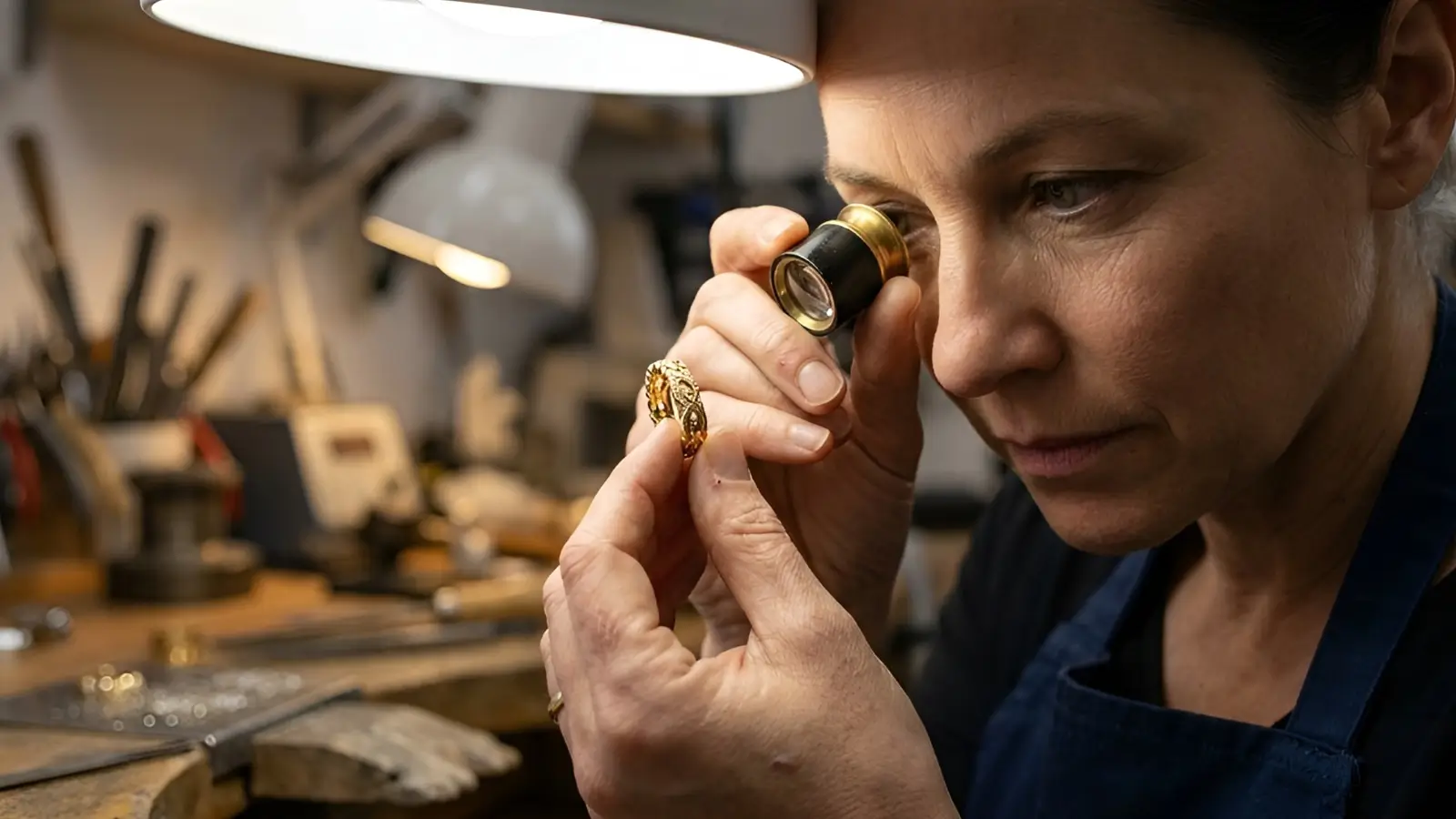
Gold plating wears away over time, particularly at high-friction points such as edges, clasps, and the inside of ring bands. Inspect these areas closely with a magnifying glass. If you can see a different-colored metal showing through a worn area, the piece is plated over a base metal. The exposed base metal will typically be yellowish brass, silvery, or reddish copper in color.
Solid gold pieces show consistent color throughout, even at worn edges and contact points. The color may change slightly in highly polished versus matte areas but should never reveal a different underlying metal.
6. Test 5: The Float and Density Test
Gold is extremely dense at approximately 19.3 grams per cubic centimeter. This is much heavier than most metals used as gold substitutes. A simple test involves dropping the piece into a glass of water. Real gold will sink immediately and decisively. Fake pieces or gold-plated items over lighter metals may sink more slowly or even float briefly.
A more precise version uses the Archimedes principle to calculate density. Weigh the piece dry, then weigh it while fully submerged in water. The density calculation using these two weights will approximate the gold content if the piece is solid gold. This test is more informative than the simple sink test but requires a precise digital scale.
Uncertain About Your Gold Piece?
Skip the guesswork. Bring any piece to JS Diamonds Inc for free, professional gold authentication using acid testing and electronic analysis.
7. Test 6: The Vinegar Test
White vinegar is a mild acid that reacts with many base metals but not with real gold. Apply a few drops of white vinegar to the piece or submerge it briefly. Real gold will not discolor, tarnish, or react in any visible way. Many base metals will show a color change or surface reaction within a few minutes.
While convenient, this test has significant limitations. Several non-gold metals also fail to react visibly to vinegar, making false positives possible. It is best used as a supplementary test alongside other methods rather than as a standalone authentication tool.
8. Test 7: The Nitric Acid Spot Test
Nitric acid is a stronger acid that reacts with most metals but not with gold. A spot test involves making a small scratch on the piece’s surface in an inconspicuous area, then applying a drop of nitric acid to the exposed metal. If the area turns green, the piece is brass or another copper-zinc alloy. If it turns milky white, it contains silver. If there is no reaction, the piece is likely solid gold.
Nitric acid is corrosive and should be handled with protective gloves and eye protection in a well-ventilated space. This test leaves a small mark on the piece. It is more commonly used by professional buyers than by private individuals.
9. Test 8: The Full Acid Test Kit
Professional acid test kits contain multiple testing acids calibrated for different karat levels, typically 10K, 14K, 18K, and 22K. The process involves rubbing the piece across a black basalt testing stone to leave a streak of metal, then applying each acid progressively to determine at which karat level the streak remains stable. This method provides both authenticity and karat confirmation in a single test.
Acid test kits are widely available online for $20 to $30 and are the most reliable at-home method for confirming both that a piece is real gold and what karat it is. Understanding your karat is essential for calculating accurate melt value, as explained in our gold calculation guide.
10. Test 9: The Electronic Gold Tester
Electronic gold testers work by measuring the electrical conductivity of metal through a probe applied to the surface. Different metals have different conductivity profiles, and the tester compares the reading against stored reference values to identify gold and indicate its approximate karat. Professional-grade electronic testers cost several hundred dollars but provide fast, non-destructive results on the spot.
Consumer-grade electronic testers are available for $30 to $100, though their accuracy is less reliable than professional instruments. They can produce false positives for certain gold alloys and may not accurately distinguish between very similar karat levels. For definitive assessment, professional testing remains superior.
11. Test 10: Professional XRF Analysis
X-ray fluorescence (XRF) analysis is the gold standard of precious metal testing in the professional industry. An XRF spectrometer fires X-rays at the surface of the metal and measures the fluorescent energy emitted, which is unique to each element. The result is an instant, precise breakdown of every metal present in the piece, including the exact percentage of gold, without any surface damage.
XRF testing confirms both the presence of gold and its exact purity level, distinguishes solid gold from gold-plated items even if the plating is thick, and identifies the alloy composition including potentially harmful metals like nickel. JS Diamonds Inc uses professional-level testing instruments to ensure every assessment is accurate and defensible. When you bring gold to our NYC gold buyers, your piece is tested properly before any offer is made.
12. Gold Test Comparison Table
| Test Method | Accuracy | Destructive? | Cost | Best For |
|---|---|---|---|---|
| Stamp Check | Moderate | No | Free | Quick first check |
| Magnet Test | Low-Moderate | No | Free | Eliminating ferrous fakes |
| Skin Discoloration | Low | No | Free | Everyday wearability check |
| Visual Inspection | Moderate | No | Free | Identifying worn plating |
| Float/Density Test | Moderate | No | Free | Estimating density |
| Acid Test Kit | High | Minor mark | $20-$30 | At-home karat confirmation |
| Electronic Tester | High | No | $30-$300 | Quick professional check |
| XRF Analysis | Highest | No | Professional use | Definitive authentication |
13. JS Diamonds Inc Serves Customers Nationwide
Whether you have inherited jewelry of uncertain origin or want to verify pieces before selling, JS Diamonds Inc provides free professional authentication at all our locations. Our team tests every piece before making any offer, ensuring complete transparency and accurate valuation.
New York City Locations
National Locations
Related Articles and Services
Frequently Asked Questions
What is the most reliable at-home test for real gold?
The acid test kit is the most reliable at-home method. It confirms both authenticity and karat level by testing the metal’s reaction to different strength acids on a testing stone. The magnet test and stamp check are useful supplements but not standalone confirmations.
Can gold-plated jewelry pass as real gold in basic tests?
Yes. Gold-plated items can pass the stamp check if stamped GP or GF, the visual test at first glance, and the magnet test if the base metal is non-magnetic. Acid testing or professional XRF analysis is the most reliable way to distinguish plated from solid gold.
Is the vinegar test accurate for testing gold?
The vinegar test has limited accuracy. Real gold will not react to white vinegar, but many non-gold metals also pass this test. It should be used as a supplementary check only, not as a standalone confirmation of authenticity.
What do stamps like 417, 585, and 750 mean on gold?
These are European fineness marks. 417 equals 10K (41.7% pure gold), 585 equals 14K (58.5% pure gold), and 750 equals 18K (75% pure gold). They are internationally recognized legitimate gold purity stamps and are equivalent to their US karat equivalents.
What stamps indicate fake or gold-plated items?
Stamps such as GF (gold-filled), GP (gold-plated), GEP (gold electroplated), RGP (rolled gold plate), and HGE (heavy gold electroplate) indicate surface-gold items, not solid gold. These are worth far less than solid gold of any karat.
Can I do an acid test at home safely?
Yes, with appropriate precautions. Acid test kits are available online for $20 to $30. Use gloves and eye protection, work in a ventilated area, and apply the acid only to a small hidden scratch mark on the piece. The mark left is minimal and typically not visible in normal wear areas.
Does real gold turn your skin green?
Real gold does not cause green discoloration. Skin staining is caused by copper or other reactive base metals in lower-karat alloys. Higher-karat gold (18K and above) with minimal base metal content almost never causes any skin reaction. Consistent green staining strongly suggests a plated or non-gold piece.
What is the most accurate professional test for gold authenticity?
X-ray fluorescence (XRF) analysis is the most accurate non-destructive professional method. It provides an instant, precise elemental breakdown of the metal without any surface damage. JS Diamonds Inc uses professional testing equipment at all locations. Book a free consultation to have your gold tested by our specialists.
